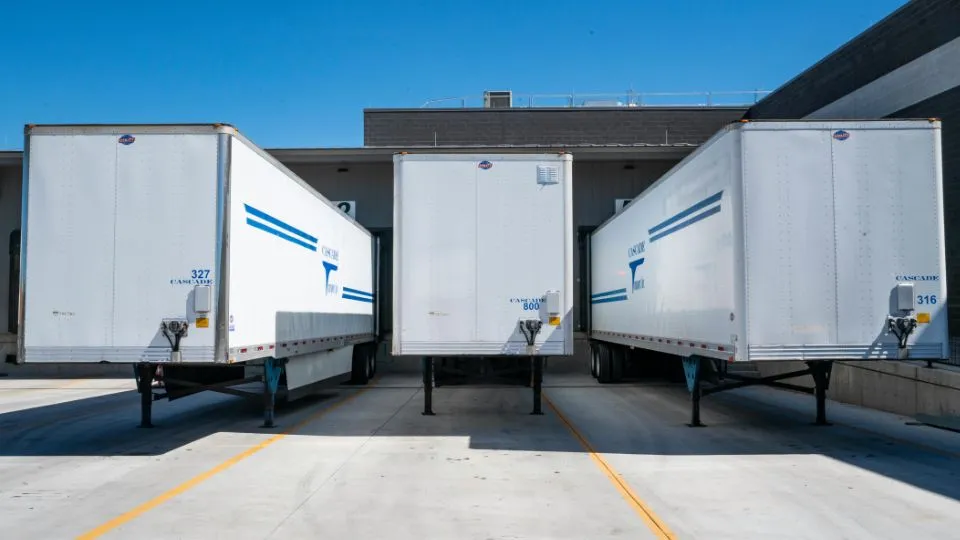
I container per il trasporto merci
A light (but useful) guide to understanding sizes, types, and when to use what.
Introduction
The importance of containers, from international trade to our daily lives, is astounding: some 20 million boxes make over 200 million trips each year, moving nearly 90 percent of the planet's goods. The idea, after all, is simple: strong, standardized and relatively insulated metal boxes.
Perhaps it is this mix of simplicity and impact that makes them fascinating: the stacks ordered into the port ready to leave, or the ships with hundreds of containers already routed to their destination.
In logistics, choosing the right container (and, when needed, the right medium) changes cost, time and safety. In this guide you will find the main types, standard sizes and typical uses, without unnecessary jargon.
Containers: standards and main measurements
Before we begin, three useful things if you are not in the industry:
- Containers are measured in feet (1 ft = 30.48 cm).
- The measurements reported are outside; inside, the space is somewhat smaller.
- ISO standards standardize measurements and codes worldwide.
External dimensions (approximate)
Tipo | Lunghezza | Larghezza | Altezza |
20' Standard | 6,06 m | 2,44 m | 2,59 m |
40' Standard | 12,19 m | 2,44 m | 2,59 m |
40' High Cube | 12,19 m | 2,44 m | 2,89 m |
Pesi indicativi
Tipo | Tara (Tare) | Portata utile (Payload) | Peso lordo max (MGW) |
20' Standard | ~2,2–2,4 t | ~28 t | 30,48 t |
40' Standard | ~3,7–3,9 t | ~26–27 t | 30,48 t |
40' High Cube | ~3,9–4,2 t | ~26–27 t | 30,48 t |
Note: these are guideline values. In practice, the CSC plate of the individual container and the road restrictions of the country/itinerary are always checked.
Types of containers (in brief)
- Dry (STD) - Closed, multipurpose. Perfect for general cargo on pallets or bulk.
- High Cube (HC) - Like the dry but higher (~+30 cm). Ideal for light and bulky volumes.
- Open Top (OT) - Tarped/opening roof. Loads from above with crane.
- Flat Rack (FR) - Without side walls. Machinery, packages out of gauge.
- Platform - Reinforced platform for exceptional/concentrated loads.
- Reefer (RF) - Refrigerated/isothermal. Cold chain (classes ATP).
- Tank (TK) - Liquids/foods/chemicals. Beware of ADR/IMDG.
Examples of use
- Dry/HC → pallets, papermaking, textiles, electronics.
- Open Top → coils, marbles, machinery loaded from above.
- Flat Rack/Platform → excavators, shovels, long pipes.
- Reefer → food and pharmaceuticals with controlled temperatures.
- Tank → wines, oils, chemicals according to classifications.
Typical problems and doubts
- Volume vs. weight: do you get over m³ or tonnes first? It changes everything.
- Site access: do you need crane, top loading, banking or side access?
- Commodity conditions: temperature controlled, ADR, special packaging.
- Pathways/derogations: underpasses, useful heights, ZTL, provincial, bridges.
FAQ flash
- Can I load 30 t in a 20'? In theory yes, but axles, road limits and balance count. It has to be verified on a route-by-country basis.
- Does a 40' HC fit everywhere? No: watch out for sheds/underpasses < 2.9 m.
- Better to be curved or vaned? (when truck is needed) The centered is more flexible in loading; the vaned protects and seals better.
Conclusion
When you have a package list (size/weight) or even just an idea of the cargo, you can start reasoning about which transportation solution is convenient, whether you need a particular set-up (Open Top, Flat Rack, Reefer, Tank) and what practical arrangements to consider (brakes, reefer feeding, permits, dock appointments).
**Are you looking for expert advice? Request a quick quote via the dedicated form: we will get back to you with timelines, costs and the most suitable solution.
Download
⬇️ Download schematic guide (PDF)
Credits and responsibilities
The information is for guidance only and is not a substitute for checking the technical specifications and regulations in effect on the selected route. For special transports/ADRs, please contact us for a dedicated consultation.